These days it’s hard to see stars due to city streetlights and building illumination, yet you can encounter miraculous landscapes just a short distance from the city. Here are some of the best spots to see the Milky Way.
Text by. Editorial Team
Gangneung Anbandegi
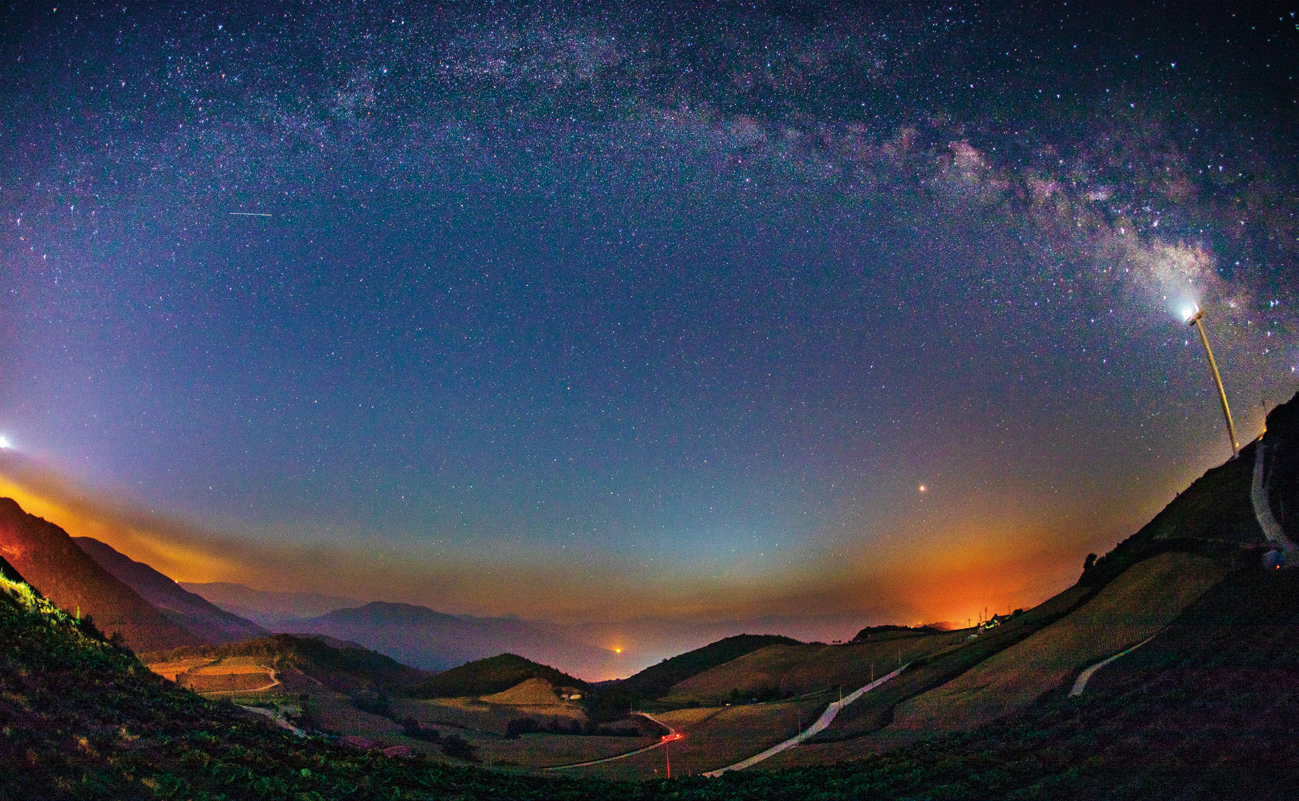
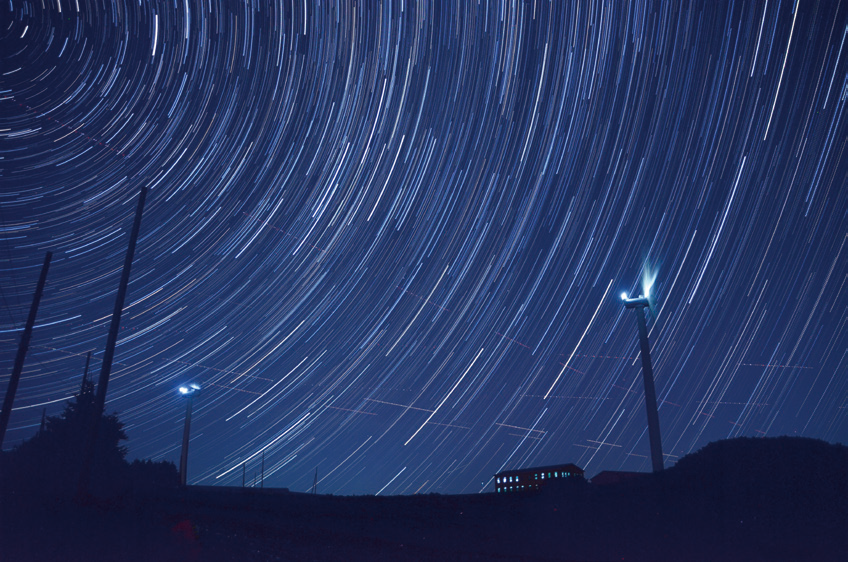
When night falls over Anbandegi in Gangneung, the vast vegetable fields are hidden in darkness, and the sky blooms. Located deep in the mountains at an altitude of 1,100 meters, Anbandegi boasts of clean air and minimal light pollution; thus making it one of Korea’s top destinations for Milky Way viewing. Standing silently in the middle of the night with no artificial lights, you are struck first by the tranquility of nature. Then, looking up at the night sky, you are awed by clusters of glittering stars. A lone wind turbine rising into the night is also overwhelming. The effort of climbing the long winding mountain roads is instantly rewarded by this scene. Meteor showers—invisible even in cities no matter how hard people try to focus—can also be spotted here easily. If you have a desperate wish to make, head to Gangneung Anbandegi.
When night falls over Anbandegi in Gangneung, the vast vegetable fields are hidden in darkness, and the sky blooms. Located deep in the mountains at an altitude of 1,100 meters, Anbandegi boasts of clean air and minimal light pollution; thus making it one of Korea’s top destinations for Milky Way viewing. Standing silently in the middle of the night with no artificial lights, you are struck first by the tranquility of nature. Then, looking up at the night sky, you are awed by clusters of glittering stars. A lone wind turbine rising into the night is also overwhelming. The effort of climbing the long winding mountain roads is instantly rewarded by this scene. Meteor showers—invisible even in cities no matter how hard people try to focus—can also be spotted here easily. If you have a desperate wish to make, head to Gangneung Anbandegi.
Near the summit of Cheongoksan Mountain at 1,256 meters above sea level, spanning Jeongseon and Pyeongchang counties in Gangwon-do, lies a wide plain called “Yukbaekmajigi.” With its area equivalent to six soccer fields combined, the open view makes it an ideal spot for night sky observation. If you visit during the blooming season of Shasta daisies (June–September), the white flowers reflect starlight, shimmering like a Milky Way on the ground. However, being a prime Milky Way spot doesn’t guarantee that you can always capture the spectacular view. Stars are obscured by bright moonlight. The darker the night, the clearer the stars are, so visiting on the last day of the lunar month with a waning moon is recommended.
A 1-14 Hoedong-ri, Mitan-myeon, Pyeongchang-gun, Gangwon-do
ⓒ Korea Amateur Astronomical Society_Kim Young-heeTaean Unyeo Beach
As the sun is about to disappear beyond the horizon, Unyeo Beach in Taean is dyed entirely red. After watching the sunset vanish absent-mindedly for a while, you will witness another kind of romance unfold. Stars gradually appear in the vast night sky, eventually filling it to create a uniquely beautiful spectacle. To reach the Milky Way viewing point at Unyeo Beach, walk a bit past the entrance to the campground to the beach. Here, a dense pine grove lines the embankment. At high tide, seawater waves reach into the grove, creating lake-like reflections. The pine grove appears like an island, mirrored by the radiant Milky Way above like a decalcomania to transform the entire area into a star-filled paradise.
As the sun is about to disappear beyond the horizon, Unyeo Beach in Taean is dyed entirely red. After watching the sunset vanish absent-mindedly for a while, you will witness another kind of romance unfold. Stars gradually appear in the vast night sky, eventually filling it to create a uniquely beautiful spectacle. To reach the Milky Way viewing point at Unyeo Beach, walk a bit past the entrance to the campground to the beach. Here, a dense pine grove lines the embankment. At high tide, seawater waves reach into the grove, creating lake-like reflections. The pine grove appears like an island, mirrored by the radiant Milky Way above like a decalcomania to transform the entire area into a star-filled paradise.
ⓒ Korea Amateur Astronomical Society_Kim Young-hee
ⓒ Korea Amateur Astronomical Society_Lee Yang-suJecheon Deokjusanseong Fortress
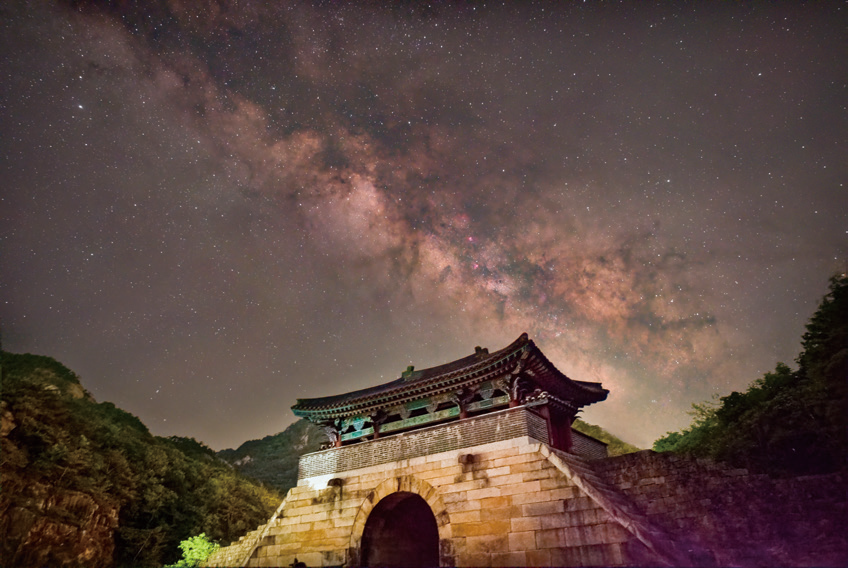
Deokjusanseong Fortress is famous as a photography hotspot. Photographers’ lenses focus on the night sky above the fortress cloaked in darkness. The Milky Way flows over the ancient walls that have stood since the Unified Silla period, creating a peaceful, timeless atmosphere. Its charm is often more vividly captured through a camera than seen with the naked eye. Especially with long-exposure settings, the star trails swirling around the fortress create mystical images like scenes from a work of art.
ⓒ Korea Amateur Astronomical Society_Lee Yang-su
Deokjusanseong Fortress is famous as a photography hotspot. Photographers’ lenses focus on the night sky above the fortress cloaked in darkness. The Milky Way flows over the ancient walls that have stood since the Unified Silla period, creating a peaceful, timeless atmosphere. Its charm is often more vividly captured through a camera than seen with the naked eye. Especially with long-exposure settings, the star trails swirling around the fortress create mystical images like scenes from a work of art.
A San 1-1, Songgye-ri, Hansu-myeon, Jecheon-si, Chungcheongbuk-do
Goheung Space Science and Astronomy Museum
In Goheung where Korea’s first space launch vehicle “Naro-1” was launched, the night sky can be observed in great detail. From the observatory at Goheung Space Science and Astronomy Museum, cutting-edge equipment allows close observation of the night sky. The main telescope in the observatory has an aperture of 800 mm, enabling views of solar system planets, distant nebulae, star clusters, and galaxies. On lucky days, even Saturn’s rings can be seen with the naked eye. Moving between various telescopes in the auxiliary observation room provides the unique experience of noticing differences between stars. Aside from the stars at night, sunspots can also be observed during the day. Even on cloudy days, visitors to the planetarium can enjoy 3D video presentations that simulate past constellations, skies from the opposite side of the Earth, or night sky viewed from Mars, which can satisfy curiosity about the unknown universe.
A 353 Janggisanseonam-gil, Doyang-eup, Goheung-gun, Jeollanam-do
H 10:00–22:00 (closed every Monday)
T 061-830-6691
Check Before Stargazing!
If you want to find places with clear stars:
Light Pollution Map
A global website showing the level of light pollution in each area. Red areas indicate heavy light pollution, whereas black areas have minimal light pollution, which is ideal for stargazing.
If you want to locate constellations in the night sky:
Stellarium
An app providing data for over 600,000 celestial bodies. It offers real-time night sky information based on your location and time, showing the positions of observable stars and celestial bodies.

 View previous
 이전호 보기