

Vigorous Efforts to Ensure Water-Quality Safety amid
Heatwaves, Droughts, and Algal Blooms
“Strengthening the Foundation for Activated Carbon
Self-Sufficiency, and Advanced Water-Purification
Essentials”
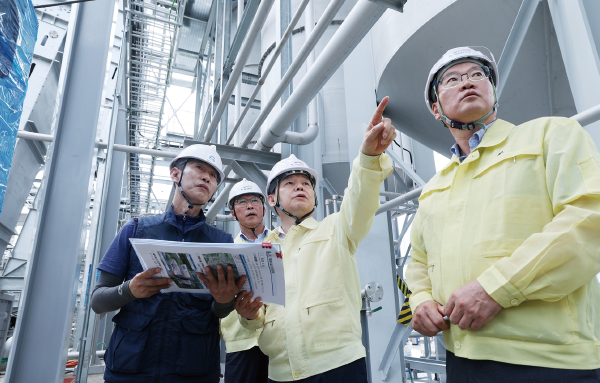
With the increasing importance of water-quality safety due
to drought and heat waves, K-water CEO Seogdae Yun visited
the Deokso Water Purification Plant in Namyangju,
Gyeonggi-do on August 13 to check the construction status of
the granular activated carbon (GAC) recycling facilities.
Furthermore, he also checked the stable supply of tap water
in preparation for the influx of algae and taste and odor
compounds from upstream water sources during the summer.
K-water is strengthening its raw water quality-management by
deploying green algae reduction equipment at raw-water
sources and selectively withdrawing deep water with less
effect on green algae. The water-purification plant operates
an advanced process at all times to ensure water-quality
safety. Granular activated carbon is a key material that
adsorbs and removes taste and odor compounds in this
process, and it is important to secure stable supply thereof
due to high dependence on foreign countries, given the
domestic supply and demand situation.
Accordingly, K-water is striving to establish an activated
carbon regeneration and circulation system to reduce
dependence on foreign countries and secure a stable supply
base. The recycling facility under construction at the
Deokso Water Purification Plant has a capacity of 48㎥ per
day, and it will circulate and supply high-quality activated
carbon on a regular basis to 10 metropolitan water
purification plants, including the Han River basin.
K-water CEO Seogdae Yun explained, “We will thoroughly
manage all stages of water supply, from water intake to
water purification, in order to actively respond to factors
that change water quality such as heatwaves, drought, and
green algae,” adding, “We will complete the construction of
the activated carbon recovery facility on time to solidify
the foundation for self-reliance in supply and demand and
enhance preemptive water management.”

Launching Global Climate-Cooperation Projects
in Partnership with the Global Green Growth Institute (GGGI)
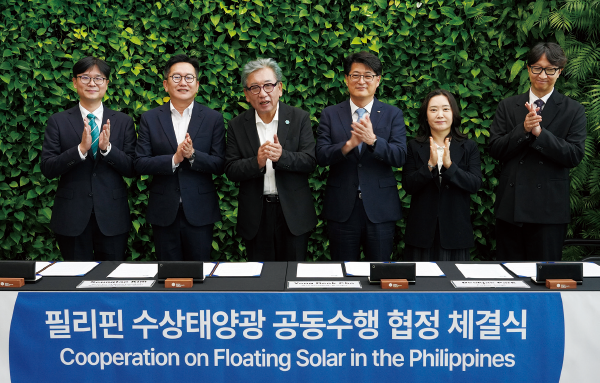
On August 19, K-water signed an agreement to jointly conduct
a preliminary feasibility study for the Bustos Dam Floating
Solar Power Development Project in the Philippines with the
Global Green Growth Institute (GGGI), the Korea Research
Institute on Climate Change, and Saegil, an accounting firm,
at the GGGI headquarters in Seoul. The project is K-water’s
first attempt to apply to an overseas dam its floating solar
power technology, which was commercialized for the first
time in Korea.
Participating organizations will look into the feasibility
of building floating solar power plants with a capacity of
up to 90 MW in Bustos Dam, Bulacan Province, Luzon Island,
the Philippines. Under the Agreement, K-water will oversee
the project and provide technical advice, while GGGI will
conduct the technical feasibility study. The Korea Research
Institute on Climate Change and accounting firm Saegil will
review the carbon and financial feasibility,
respectively.
Starting with Hapcheon Dam in 2012, K-water is currently
operating floating solar power facilities with a total
capacity of 105 MW at seven locations across the country.
The Agreement signed this time is also the first milestone
that led to actual business through the Agreement to
Strengthen Cooperation in Response to Climate Change and
Sustainable Water Management signed between K-water and GGGI
in July.
Yongdeok Cho, head of the K-water Global Business Division,
remarked, “This is the starting point of practical
cooperation connecting floating solar power know-how and
GGGI’s global climate finance network,” adding, “We are
fully committed to ensuring that it becomes a successful
international greenhouse gas reduction project.”

On-site Inspections
to Respond to Drought
in
Gyeongsangbuk-do
“All-out Efforts to Supply Water to 460,000 Local Residents”
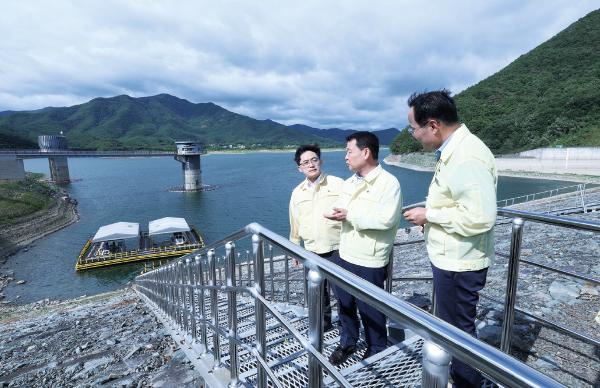
Seogdae Yun, CEO of K-water, visited Yeongcheon Dam in the Gyeongsangbuk-do region and the proposed Hangsa Dam site in Pohang on August 12 and checked their readiness to respond to drought and water disasters. As the water-storage rate of Yeongcheon Dam has decreased due to the recent drought, he looked into the water-supply system and urged that all efforts be made to provide customized on-site support, such as emergency water supply in preparation for rising salinity in the Hyeongsan River. Furthermore, he visited the proposed Hangsa Dam site to check up on the project progress, and discuss plans for an early construction start with the local community. K-water plans to monitor the water retention status of major dams across the country 24 hours a day to prepare for droughts, while strengthening stable water supply and disaster-response capabilities by expanding the mid- to long-term water-supply infrastructure.

Signing a Framework Agreement with the Gyeonggi Housing & Urban Development Corporation for the Hanam Gyosan Hydrothermal Energy Supply Pilot Project
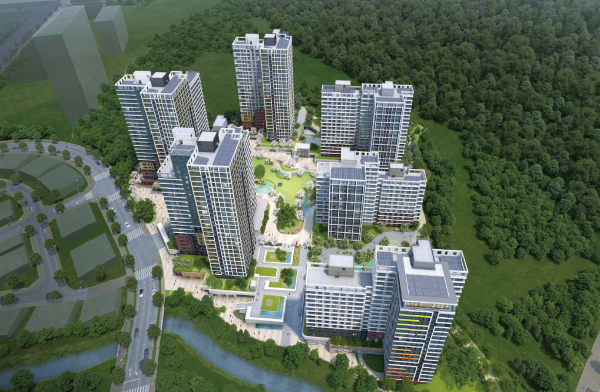
On July 30, K-water signed a framework agreement with the Gyeonggi Housing and Urban Development Corporation for the Hydrothermal Energy Supply Pilot Project for Hanam Gyosan Apartments. The project targets 763 households in Block A8 of the Hanam Gyosan public housing district, and it is planned to supply 1,000 RT (3.5 MW) of hydrothermal energy by utilizing approximately 17,000 tons per day of raw water from the metropolitan water-supply system. This is the first case in Korea of directly applying hydrothermal energy, which has till now been mainly used in large buildings or complexes, to each household in an apartment complex. Residents can now cool and heat their apartments without any need for an outdoor air conditioner unit, and this is expected to reduce energy use by about 35% compared to existing systems.

Sharing K-water’s AI and Digital Twin Advanced Water Management Expertise with California State University
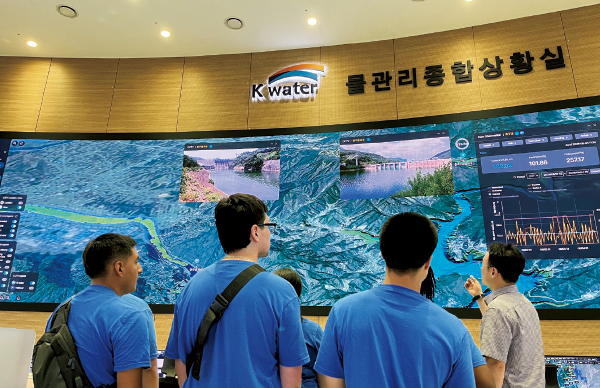
From July 27 to August 8, K-water provided the Summer
Semester for AI-based Korean Digital Twin Water Management
course for professors and eight students from California
State University Bakersfield (CSUB). It was conducted as
part of the MOU signed between the two institutions last
year, and CSUB agreed to officially grant two regular
credits for bachelor’s degrees.
Participants visited the Water Management Control Center,
the National Drought Information-Analysis Center, the Gosan
AI Water Purification Plant, and the Sihwa Tidal Power Plant
to learn cutting-edge water-management technologies and
field application cases based on AI and digital twins. Going
forward, the two institutions plan to continue strengthening
human and technological exchanges, including expanding
training programs and dispatching employees.

Joining Hands with Gyeongbuk Creative Economy Innovation Center to Advance the Climate Tech Industry in the Gyeongsangbuk-do Region
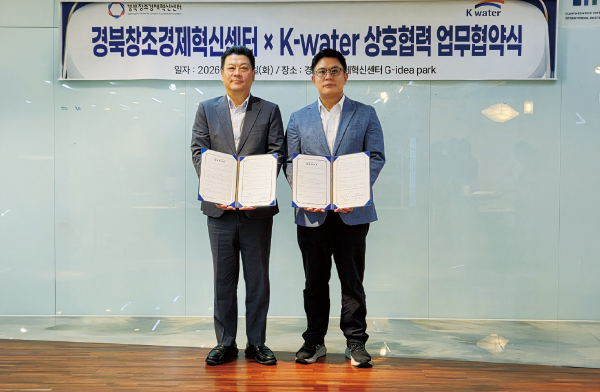
On August 4, K-water signed an MOU for Revitalizing Open
Innovation with the Gyeongbuk Creative Economy Innovation
Center, and entered into a three-party (including startups
in the Gyeongsangbuk-do region) proof of concept (PoC)
agreement. The purpose of the MOU was to revitalize the
local startup ecosystem by identifying promising local
startups and supporting the verification and
commercialization of innovative technologies.
K-water plans to provide such support by sharing its
infrastructure, including the national K-Testbed and Water
Round. Going forward, the two organizations plan to jointly
identify promising startups in the climate technology field
and support the growth of local innovative companies.